
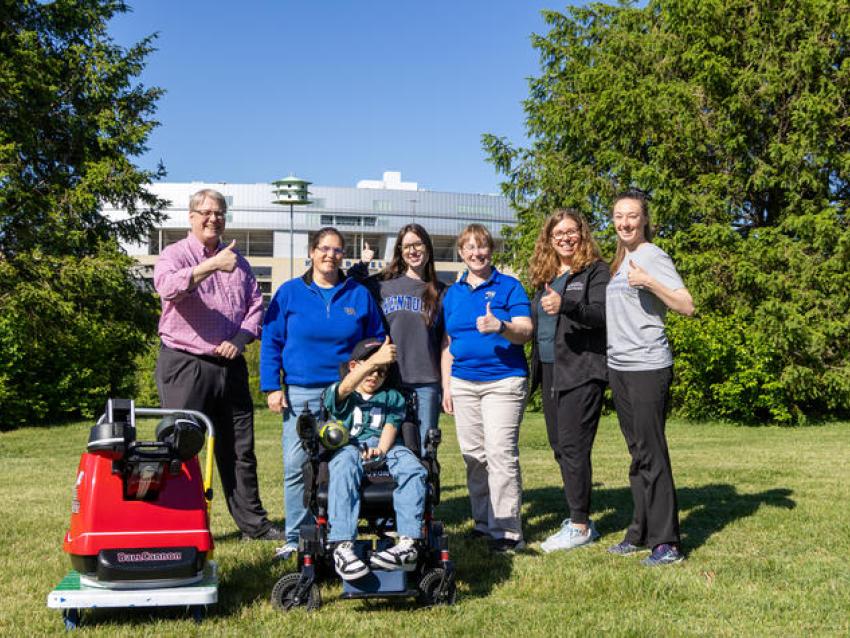
Back in the game: UK team develops football launcher to help teen play
LEXINGTON, Ky. (Oct. 12, 2026) – When Sam Roberts began his therapy services at the University of Kentucky’s Child Development Center of the Bluegrass, he told his team he missed walking and wished he could throw a football with his friends.
Sam, a 16-year-old from Lancaster, Kentucky, has been diagnosed with 4H leukodystrophy. This is a rare genetic disorder that affects the part of the brain that helps nerve cells communicate with each other. The symptoms can vary, but typically include delayed motor skills, difficulty with balance and coordination, tremors, speech or learning difficulties and muscle stiffness.
4H leukodystrophy is a rare disorder, with an estimated 300 to 600 known patients worldwide. Currently, there is no cure that can reverse the underlying genetic condition.
“With leukodystrophy, Sam’s verbal communication will become increasingly difficult for him over time making augmentative and alternative communication increasingly important to allow him to keep participating in activities and communicate with the people around him,” said Elise Craig, a speech language pathologist with UK Pediatric Therapies and the UK College of Health Sciences.
For Sam, his care focuses on managing symptoms, supporting development and helping him adapt to changes. Through the Child Development Center of the Bluegrass and UK Pediatric Therapies, Sam participates in physical therapy, occupational therapy and speech therapy.
“Sam is always in a state of constant change,” said Maria Oney, Sam’s mother. “It’s hard to set goals of progress, but the Child Development Center has been phenomenal."
Instead of being overly focused on goals of progress, Sam’s team took the approach of asking him what he wanted the most help with and how they could work with him to make sure he’s able to participate in activities and have fun just as other teenagers do.
Roblox and football are at the top of Sam’s fun list.
Sam loved playing Roblox, the online gaming platform, but over time he began to lose some strength and control in his hands. This made it difficult for him to play the video game with a standard controller as he struggled with pressing the correct keys.
Through UK’s Toys with a Purpose initiative, Sam was able to receive an adapted n-ABLER joystick and keyboard that was customized and set up specifically to meet his needs. With the adapted device, Sam was able to continue playing the game he loved without the frustration of pressing incorrect buttons.
“Having an activity that you love is such an important part of everyday life that people take for granted,” Craig said. “Assistive technology can make an incredible difference for people who would otherwise have difficulty participating in an activity. It is so important to have groups that work on adapted toys and devices because this both increases awareness of the need for adapted toys and devices and improves access for those that benefit from them.”
Toys with a Purpose, housed in the College of Health Sciences, is an adapted toy lending library program dedicated to providing adapted toys and books so all children can play, learn and grow. The program is led by Patrick Kitzman, Ph.D., physical therapist and professor in the College of Health Sciences Department of Physical Therapy and the Rehabilitation and Health Sciences Ph.D. Program.
Once Sam’s team was able to check Roblox off his list, it was time to figure out how to tackle his other request — being able to participate in football.
“I got to know Sam through his therapists, and he is a remarkable young man,” Kitzman said. “He is a huge fan of his high school football team and wanted to be able to play catch with the players. We love challenges like this. We are always trying to create the really cool toys and devices that just happen to also be accessible by as many kids as possible. We are just trying to level the playing field for everyone.”
Kitzman began brainstorming ideas on how Toys with a Purpose could help create a device to get Sam throwing a football again. He decided to also call on UK’s Stanley and Karen Pigman College of Engineering to see what they could do to help.
Each year, seniors in the College of Engineering participate in a year-long capstone project. Kitzman has collaborated with Regina Hannemann, Ph.D., senior lecturer of electrical and computer engineering, multiple times over the years to come up with capstone projects that involve adapting toys and devices.
Together they decided designing a football throwing device for Sam would make a great project for a group of seniors to work on.
“Our class was presented with 20 different projects to choose from,” said Audra Proffitt, 2026 College of Engineering graduate. “Sam’s grabbed my attention immediately. I knew I wanted to make this device for him. I was determined to create a product that works for Sam and that our team would be proud of.”
Proffitt was among a small group of engineering students that would also be working with her to create a football throwing device for Sam.
The group had an initial meeting with Kitzman to learn more about Sam and the type of device they would need to create to fit his needs. They found that a football launcher already existed, but their job was to build new features to adapt the launcher to work seamlessly with Sam’s wheelchair functions.
This led to the team’s first bump in the road. As they were preparing to order a football launcher called the Ball Cannon, made by Fred Hafer at Frevon Inc., they found that it had been discontinued in 2020.
“I’m very forward oriented, so I took action immediately,” Proffitt said. “I found the phone number associated with Mr. Hafer’s company then called and asked if I could speak to him about our project. I explained our capstone project and asked if there was a possibility for us to buy any kind of Ball Cannon they might still have. It’s crazy what a 10-minute phone call can do.”
One phone call put the group right back on track. Hafer was excited to learn about the project and wanted to do everything possible to help.
Two weeks later, a Ball Cannon arrived. Hafer donated the entire system to them at no cost, except for shipping fees. A box of Nerf footballs and Ball Cannon merch was also sent to be gifted to Sam.
Now it was time for them to get to work figuring out how they could adapt it to work with Sam’s wheelchair.
Proffitt met with Sam’s therapists to get an idea of devices he already uses and has success with. They mentioned his adapted device for Roblox and how the joystick and keyboard are easy for him to use.
“Our main goal was to create something that was as familiar to him as possible,” Proffitt said. “I didn't want him to adapt to a new complex system. We knew he was familiar with how his Roblox game worked, so we had the idea to base our device around that.”
The team decided they would create a program that could operate on Sam’s tablet, and the program would be set up with controls similar to Roblox. They used an adapted joystick and the program connected to the Ball Cannon, allowing Sam to aim and launch the football all on his own.
“Using computer programming in Python, I was able to map the joystick to specific commands that I wanted such as left and right,” Proffitt said. “It was designed so that we were triggering the launch just from pressing the button on the joystick.”
This set up allows Sam to easily have control over the Ball Cannon and he can launch it with a button that is easy for him to use.
Each command from the program was connected to an entire motor system that another team member, Matthew Stokes, 2026 College of Engineering graduate, built from the ground up. The Ball Cannon sits on a lazy Susan rotating configuration that was 3D printed by Stokes. This configuration and programming allow the device to be moved and aimed based on the joystick movements.
“The original idea for the lazy Susan design actually came from a microwave,” Stokes said. “It was super fun to 3D print and test with different gear styles and ratios to see what would work best. We also had to do some research on material types to make sure the material we printed would be durable and last since one of our main goals for the project was to design something that would provide Sam with years of fun.”
After months of work, coding the program and building the adapted configuration for the Ball Cannon, the team was ready to present their final product to Sam, his family and therapists.
In May, just a few days before graduation, Proffitt packed up the adapted Ball Cannon and headed toward the Child Development Center of the Bluegrass to meet up with Sam.
When he first saw the device, his eyes lit up and he had a big smile on his face as he gave everyone a thumbs up.
Then it was time to put it to the test. Sam and his team found a large open area outside to throw the football. Just as planned, he was familiar with the control set up as it mimicked Roblox and he had experience with using the joystick. After a few more explanations from Proffitt on how to aim and adjust the speed, Sam was ready to launch the ball.
Kitzman went down the field and prepared to receive the pass. Sam refamiliarized himself with the controls and then his first pass went soaring through the air as his fans on the sidelines erupted into cheers.
“It was amazing to see Sam hit the button to launch the first football and see his excitement,” Kitzman said. “The excitement of seeing a person able to perform a task they did not think they would get a chance to perform is the moment we all live for. It was also gratifying to see the look on our engineer’s face when she saw the impact the work of her team had on this person.”
For Oney, watching her son gain the ability to do something he loves is a moment she will never forget.
“It felt amazing to have a team come together to create the football thrower for Sam,” Oney said. “He loves his high school football team and has desperately wanted to take part. This thrower will give him the opportunity to participate in practices with the team and feel like a part of it.”
After having an afternoon of passing the football with his care team, it was time to pack up the adapted Ball Cannon for Sam to take home.
“Seeing his face light up, seeing his mom and caregivers, it made the entire year worth it,” Proffitt said. “I’d do it all over again. It was absolutely the most rewarding part of my senior year.”
This fall, Sam will get to put the Ball Cannon to use on the football field with his friends and teammates.
“We have never worked with a team like we have here,” Oney said. “The therapists stay engaged with Sam and help him have fun. They listen to his feedback and adapt from there. We are so grateful to have found a team that has both the creativity and the resources that we have here at UK’s Child Development Center of the Bluegrass.”